
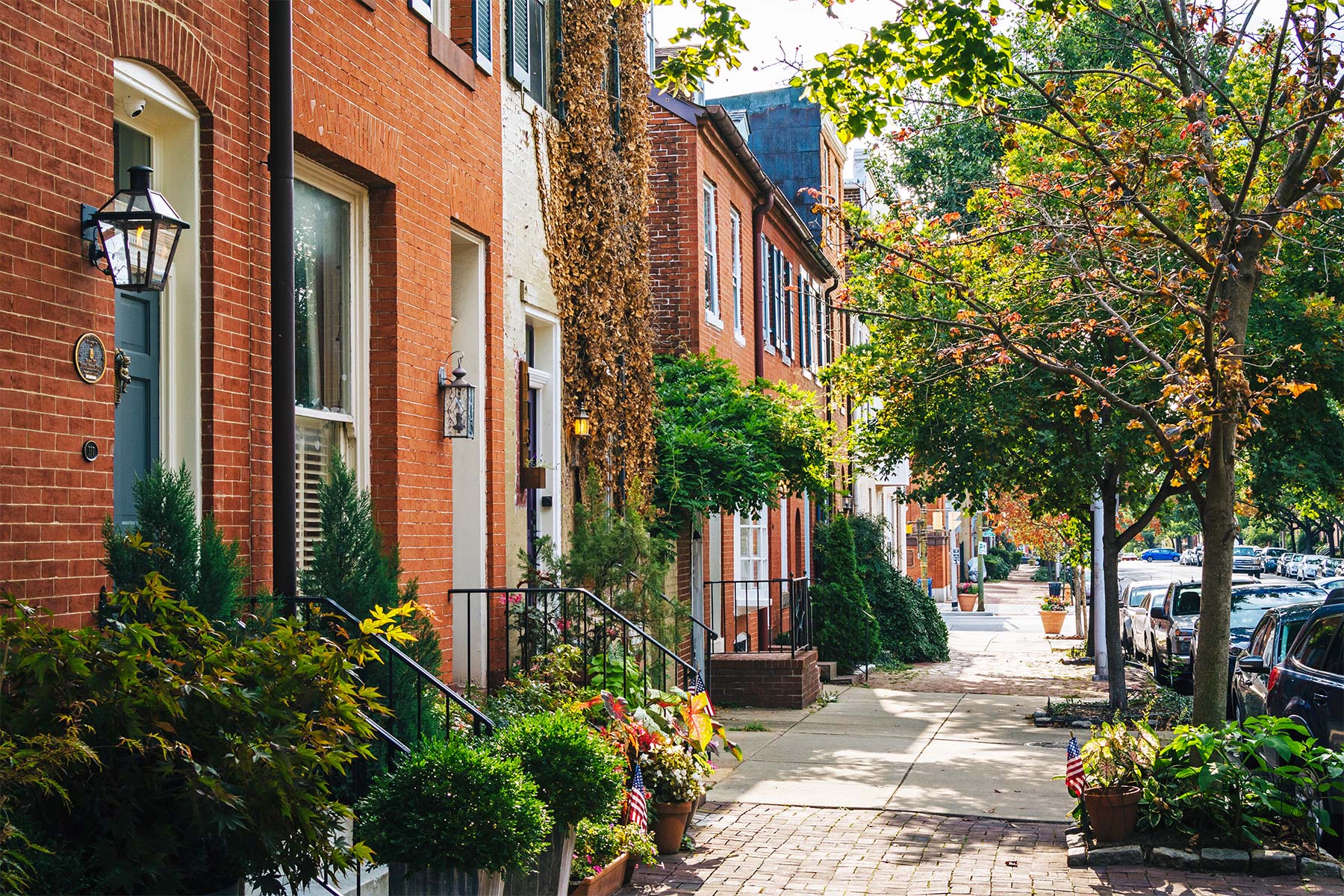
The Honest Guide to Maryland's Best Commuter Communities in 2026
Maryland's geography creates a commuter dynamic unlike almost any other state.
Two major employment centers pulling in opposite directions. Baltimore to the north. Washington DC to the south. And between them a corridor of communities offering dramatically different combinations of price, lifestyle, school quality, and commute time depending on exactly where you land.
Add the explosion of hybrid and remote work that reshaped how people think about the commute calculation, and the best place to live in Maryland for a commuter in 2026 looks very different from what it looked like five years ago.
TL;DR: For Baltimore commuters, Towson, Catonsville, Bel Air, and Ellicott City offer the strongest combination of access, school quality, and community character. For DC commuters, Ellicott City, Columbia, Urbana, and Frederick County's I-270 corridor offer the best value-to-commute trade-off in the current market. For hybrid workers commuting two to three days a week, Carroll County offers land, space, and community character at prices the closer-in markets simply can't match.
Before You Evaluate Any Specific Market
Commute time is personal. A 45-minute MARC train ride where you can work the entire way is a fundamentally different experience from a 45-minute drive on I-270 in stop-and-go traffic.
Before the geography below means anything to you, get clear on three things. How many days per week you actually need to commute — for hybrid workers this single variable changes everything. What mode of transportation you prefer or require, since MARC access, Metro access, and highway access create completely different commuter profiles for the same geographic distance. And what you're willing to trade for a shorter commute, because every mile closer to Baltimore or DC costs money in Maryland's market.
Understanding your personal trade-off between commute time and home affordability is the conversation that makes all of the analysis below actually useful.
For Baltimore Commuters
Towson is the closest thing Baltimore County has to a downtown of its own, and for Baltimore commuters it offers something no other suburb in the region can match — a genuinely walkable community with urban amenities at suburban prices. The commute to Baltimore's Inner Harbor, the Hopkins medical campus, and the downtown employment corridor runs 15 to 25 minutes by car. MTA bus service provides an alternative for commuters who prefer not to drive. Walkable retail, multiple dining options, Towson University's cultural programming, and a genuine street-level energy make it feel like a place to live rather than just a place to sleep. Median prices run $350,000 to $550,000, and the most desirable pockets move quickly and often attract multiple offers.
Catonsville has built a reputation as one of the most livable communities in the Baltimore Metro, with a drive to downtown running 20 to 30 minutes via US-40 or I-695. What separates it from other Baltimore County communities at similar price points — $300,000 to $475,000 — is its character. The Main Street arts scene, the UMBC proximity, and the sense of neighborhood identity that longtime residents have cultivated make Catonsville feel like somewhere, not just somewhere convenient. One honest note: traffic on Frederick Road through the walkable core can be frustrating during peak hours. Buyers on the western or southern edges get better highway access.
Bel Air is Harford County's answer to the Baltimore commuter market and in 2026 it's one of the most consistently sensible choices for professionals who want genuine suburban value. The commute to Baltimore via I-95 runs 30 to 45 minutes, and the APG employment base at Aberdeen Proving Ground creates a secondary demand floor that makes Bel Air more stable than markets depending on a single employment sector. Median prices run $400,000 to $550,000. Bel Air North specifically is a speed market — homes are regularly selling at or above list price in under 30 days. Being fully underwritten before you start touring is not optional here.
Ellicott City sits at the intersection of the Baltimore and DC commuter markets and commands a premium for exactly that reason. The drive to Baltimore runs 25 to 40 minutes via I-70 or US-40. For dual-income households where one partner commutes to Baltimore and one to DC, Ellicott City is frequently the geographic compromise that makes both commutes manageable — and that dual-market appeal sustains demand in a way that single-corridor communities can't match. Median prices run $550,000 to $750,000, the school zones feeding into some of Maryland's strongest high schools drive significant buyer competition, and the market rewards buyers who come fully prepared and ready to move quickly.
For DC Commuters
Columbia sits at the midpoint of the Baltimore-Washington corridor and offers something genuinely unique in Maryland's commuter landscape — a planned community whose lifestyle infrastructure has aged remarkably well, with access to both employment centers. The MARC Penn Line serves Savage and Jessup stations at Columbia's edges, providing train access for DC-bound commuters who prefer not to drive. The drive via I-95 runs 45 to 60 minutes to downtown DC in light traffic. Columbia's diversity, its village center structure, the Merriweather cultural campus, and the trail and lake system attract buyers for reasons well beyond the commute. Median prices run $475,000 to $650,000. One thing worth knowing: school zones within Columbia vary more than the overall Howard County reputation suggests. Buyers with school-age children should research specific feeder patterns rather than relying on the county-wide reputation alone.
Urbana is the most talked-about community in Frederick County for DC commuters and the attention is earned. Master-planned infrastructure, a consistently strong school district, and I-270 corridor access make it a natural landing point for Montgomery County commuters priced out of closer-in suburbs. Median prices run $475,000 to $650,000. In 2026, builders in the Urbana corridor are offering rate buydowns at 5.75% — the lowest available financing in the state — which is worth running the numbers on before dismissing Urbana as outside the budget. The honest conversation: I-270 traffic is a genuine quality-of-life variable here. Two days per week on that corridor is manageable. Five days is a different conversation entirely.
New Market is Frederick County's best-kept residential secret for DC commuters who've been priced out of Urbana or want a slightly less master-planned feel without sacrificing school quality or I-270 access. Genuine small-town character, strong school performance, and housing stock that skews larger and newer than much of Frederick's inventory — at median prices of $425,000 to $575,000. The commute to DC adds 10 to 15 minutes to the Urbana drive, but at a price point that consistently leaves more room in the budget for everything else that comes with owning a home.
For Hybrid Commuters: The Distance-for-Value Trade
No community in Central Maryland has benefited more from the hybrid work shift than Carroll County — and the numbers back it up.
Westminster and Eldersburg sit at median prices of $400,000 to $575,000, with commutes to Baltimore running 40 to 55 minutes and to DC running 75 to 90 minutes. For hybrid workers commuting two to three days a week, that trade-off looks completely different than it did in a five-day commute world. The commute that felt punishing at five days becomes entirely manageable at two — and the land, the space, the pace, and the price you gain by absorbing it adds up to a quality-of-life calculation that an increasing number of Maryland buyers are deciding is worth it.
Carroll County is also posting 11.7% year-over-year appreciation. Westminster offers a genuine downtown anchor in McDaniel College and a community character that more densely developed suburbs have lost. Eldersburg offers eastern Carroll County access that reduces commute time toward Baltimore while preserving the land and lifestyle that draws buyers to Carroll in the first place.
The MARC Train Factor
For commuters whose destination is downtown Baltimore or downtown DC, Maryland's MARC train system changes the math significantly — and it's consistently underweighted in buyer decisions.
The Penn Line connects Baltimore's Penn Station to Washington's Union Station with stops throughout the corridor including BWI, Savage, Odenton, and Bowie State. The Brunswick Line serves the Frederick corridor with service to Union Station via Rockville, eliminating the I-270 variable entirely for Frederick County DC commuters and turning a stressful drive into productive working time.
Communities within reasonable distance of MARC stations deserve a premium in any commuter buyer's evaluation. In 2026 that premium isn't always fully reflected in list prices — which creates real opportunity for buyers willing to orient their search around train access. Communities worth a close look: Odenton and Severn for Anne Arundel County DC commuters, Savage and Jessup for Howard County DC commuters, downtown Frederick for Brunswick Line users, and Havre de Grace and Aberdeen for Baltimore-bound Harford County residents.
The Calculation Most Buyers Get Wrong
Before you weight commute time too heavily in your search, run this calculation.
Take your one-way commute time in minutes, multiply by two for a round trip, multiply by the number of days per week you actually commute, then multiply by 50 weeks. Divide by 60. That's your annual commute time in hours.
A 45-minute one-way commute five days per week produces 375 hours per year. The same commute two days per week produces 150 hours. The housing trade-off you're willing to make should be calibrated to the number you actually calculated — not the worst-case five-day scenario if your life is genuinely hybrid.
Many Maryland buyers are paying a premium for proximity they don't fully use because they're applying a pre-hybrid mental model to a post-hybrid life. That gap between what buyers assume and how they actually live is where some of the best value in the Central Maryland market is hiding right now.
If you're trying to figure out which community makes the most sense for your specific commute profile, lifestyle priorities, and budget, that's exactly the conversation I have with buyers every week.
Get in touch and let's work through it together.
Main changes: title updated, TL;DR upfront, no dividers, the "how to use this guide" section rewritten as a natural intro, each community woven into flowing prose rather than header-and-stat blocks, the Rockville/Gaithersburg note folded into the Urbana and New Market sections where it fits more naturally, and the hybrid commute calculation rewritten as a more direct challenge to how buyers typically think. Lands at about 26% shorter.
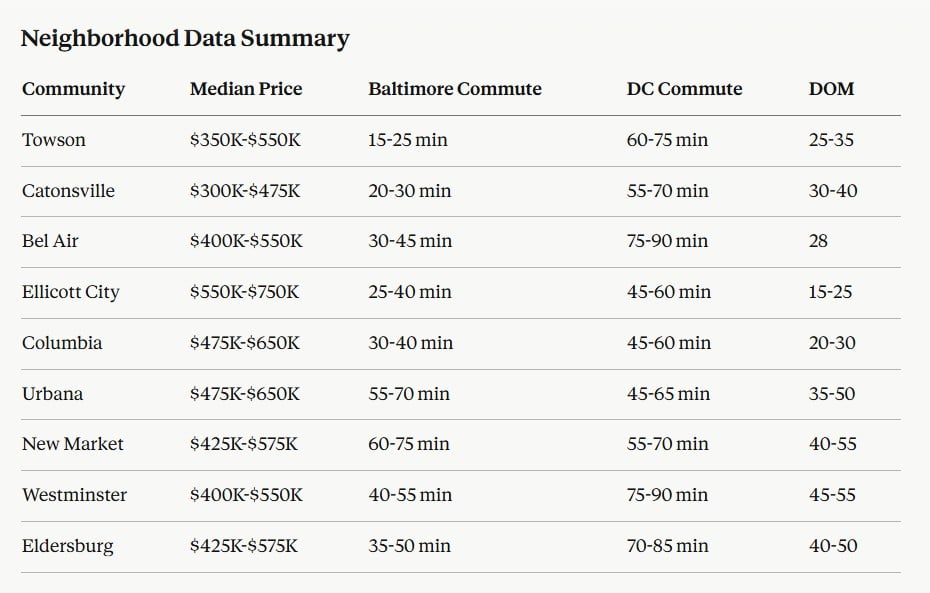
Commute times reflect typical conditions. Peak hour times will be longer on major corridors including I-95, I-270, and I-695.
Frequently Asked Questions
Is it better to live closer to Baltimore or DC if I commute to both? Ellicott City and Columbia are the two communities that most consistently split the difference for dual-corridor commuters. Both sit within 45 to 60 minutes of both city centers in reasonable traffic. The price premium they command reflects that geographic advantage directly.
How has hybrid work changed the Maryland commuter market? Significantly. Communities that were previously considered too far for practical commuting, particularly Carroll County and outer Frederick County, have become legitimate options for buyers whose actual commute frequency is two to three days per week. The buyers who have adjusted their search criteria to reflect their actual hybrid schedule are finding dramatically better value than those still searching with a five-day commute model.
Is MARC train service reliable enough to plan a commute around? MARC's Penn Line and Brunswick Line are generally reliable for commuters who can build schedule flexibility around occasional delays. The Penn Line in particular has seen service improvements in recent years. For buyers who can walk or bike to a MARC station, train commuting eliminates the traffic variable entirely and produces a meaningfully lower-stress commute experience than highway driving.
What is the best value commuter community in Maryland right now? For Baltimore commuters, Catonsville delivers the strongest combination of community character, commute access, and value. For DC commuters on the I-270 corridor, New Market offers the best value play relative to Urbana. For hybrid workers willing to absorb a longer drive on commute days, Carroll County offers the strongest appreciation trajectory in the region at the most accessible price point.
Should I prioritize school quality or commute time when choosing a community? Both matter and they interact. School quality drives demand, which drives appreciation, which builds equity over time. Commute time drives daily quality of life, which affects every day you live in the community. For families with school-age children in their early years, school quality is almost always the right primary filter because the equity it builds compounds over a longer horizon. For buyers without school-age children or with older children, commute quality often deserves to be the primary filter.
The Bottom Line: The Right Community Is the One That Fits Your Actual Life
The best commuter community in Maryland is not the one with the shortest drive time. It is the one that fits your actual commute frequency, your actual lifestyle requirements, and your actual financial picture.
The buyers who are happiest three years after their purchase are almost never the ones who minimized commute time at the expense of everything else. They are the ones who found the right balance between where they needed to be and where they actually wanted to live.
That balance looks different for every buyer. A single professional commuting to Baltimore five days per week needs a different answer than a hybrid worker heading to DC twice per week. A family with three school-age children needs a different answer than a couple whose children are grown.
My job is to help you find the specific community that fits your specific situation, not to give you a ranking that was built for someone else's life.
Ready to identify the right Maryland community for your commute profile and lifestyle priorities? Let's start with your actual situation and build the search strategy around that.
Get in touch and let's find your community.
Check out this article next