

Flipping Houses in Central Maryland: Carroll County vs. Frederick County
If you are underwriting a fix-and-flip project in the current Central Maryland market based on corporate spreadsheet templates, your risk models are dangerously outdated. Many retail investors look at the steady median home price appreciation across our region and assume that any distressed property can be forced into a profitable margin. They buy into a neighborhood based on a generic online valuation, plug in flat construction costs, and assume they will exit with a clean 30% return.
Then reality hits.
The market has shifted into a highly sensitive, quality-driven environment. Buyers are pushing back hard against cheap, superficial builder-grade finishes, and modern financing costs will punish anyone who experiences unexpected project delays.
My perspective on investment underwriting is shaped by nearly two decades in local real estate, beginning with a heavy foundational background in property valuation, structural appraisal, and Broker Price Opinions. I look at investment properties through raw transactional data and physical engineering. If you want to successfully flip houses right now, you must abandon broad generalizations and evaluate the hyper-local math governing your acquisition and construction choices across the counties I analyze every single day.
Quick Answer
Successful house flipping in Central Maryland requires adhering to a strict 70% of After Repair Value rule, subtracting precise, inflation-adjusted local construction costs. In the current 2026 landscape, Carroll County offers a more predictable, entry-level suburban sandbox with a median sale price near $470,000 and lower initial acquisition friction. Frederick County presents a higher equity ceiling with a median price hovering near $515,000, but introduces stiffer bidding competition and higher holding cost risks.
Key Takeaways
- The Margin Compressed: General flipping margins have compressed due to persistent material costs and elevated holding expenses. Profitability depends entirely on purchase-price discipline.
- The Financing Velocity Factor: The speed of your construction timeline directly dictates your ultimate return. Every extra 30 days spent in the escrow or permitting pipeline strips up to 1.5% off your net margins.
- The Finishing Shift: Modern buyers demand mechanical soundness over purely cosmetic finishes. Upgrading a main electrical panel or HVAC system moves the needle faster than installing trendy backsplashes.
- Hyper-Local Divergence: Entry-level rural and suburban layouts in Carroll County offer faster asset turnover, while historic urban infills in Frederick demand deeper capital stacks.
Side-by-Side Analysis: Geographic and Strategic Underwriting
To understand how the math operates in the current real estate environment, you must evaluate asset performance across different locations and construction strategies. Here are two real-world investment scenarios playing out side-by-side in my active submarkets.
Strategy A: The Suburban Value Play (Carroll County)
This strategy targets a traditional single-family home or split-foyer footprint in Westminster or Taneytown. The property requires a comprehensive mechanical overhaul, full kitchen and bath modernization, and cosmetic updates, but does not demand major structural changes or complex historic architectural oversight.
Strategy B: The Premium High-Demand Infill (Frederick County)
This strategy targets a detached property or older home within high-demand commuter tracks like Frederick City, Urbana, or New Market. The property demands extensive structural work, high-end design elements to compete with premium new construction, and introduces tighter municipal permitting parameters.
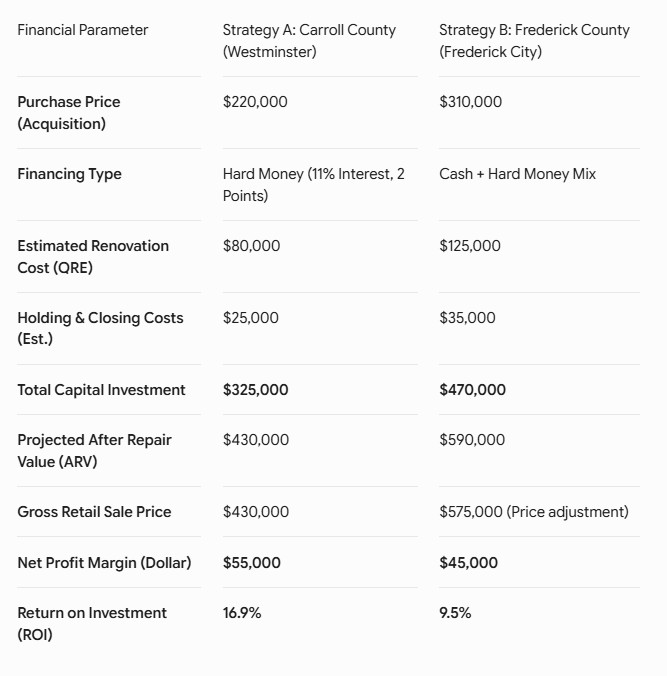
Deconstructing the Math: Strategy A vs. Strategy B
When you evaluate these side-by-side scenarios through an appraisal lens, it becomes instantly clear why higher entry-point investments can frequently yield lower net returns for real estate developers.
Why the Carroll County Footprint Wins on Velocity
In Strategy A, the entry price of $220,000 leaves a healthy margin for error. The target buyer profile for a finished $430,000 home in Carroll County represents the largest demographic pool in the region: move-up buyers and families looking for space outside the immediate Baltimore and D.C. core. Because inventory in this sub-$450,000 single-family price bracket remains highly restricted, a pristine, fully updated home in Westminster or Sykesville sells rapidly, keeping holding costs tightly contained.
Why the Frederick County Footprint Introduces Compression
In Strategy B, the investor fell into the trap of overestimating the target neighborhood's ceiling. While a $590,000 ARV appeared achievable on paper based on premium custom listings in New Market or Urbana, the general buyer pool for a $550,000-plus property is highly discerning.
The renovation ran 45 days over schedule because matching high-end design trends required specialized trade contractors. Those extra days in the pipeline under a high-interest hard money loan drained thousands of dollars in pure profit, ultimately forcing a retail price correction just to move the asset off the ledger.
The Hard Money Framework: Financing Under the Microscope
Most professional fix-and-flip operators do not utilize traditional conventional mortgages to fund construction. They deploy hard money loans: short-term, asset-based lending mechanisms that prioritize the underlying property value over the borrower's personal income file.
Understanding the real operational cost of leverage is vital to protecting your project cash flow. Current Maryland hard money rates generally run between 10% and 12% annually, charged monthly and carried throughout the entire construction lifecycle. Origination points typically land between 1 and 2, paid upfront at closing and adding directly to your acquisition capital requirements. Renovation funds are held in escrow and released in structured draw phases only after an inspector physically verifies that specific construction milestones have been completed.
Navigating the Draw Schedule Safely
Hard money lenders do not hand you a check for the entire renovation budget at settlement. They hold the construction capital in a secure escrow account and release it through a series of structured draw phases.
For instance, Phase 1 might allocate $20,000 for roof replacement and structural demolition. Once your crew completes the tasks, the lender sends a local inspector to physically verify the quality of the work. If approved, they release the next draw allotment. If your contractor mismanages their timeline or demands upfront payment before work is completed, your draw schedule freezes, stalling the entire job while your high-interest monthly carrying costs continue to run.
Investors Who Win vs. Investors Who Lose
The significance of precise pre-acquisition underwriting is best understood by looking at two different investment approaches deployed on similar assets across these markets.
The Investor Who Loses: Emotion Over Data
An investor identifies a distressed split-foyer in a Carroll County zip code they like. They run a quick back-of-napkin ARV estimate based on active listings rather than closed sales, plug in a flat $80,000 renovation budget without pulling contractor bids, and submit an offer. The acquisition clears at $235,000.
During construction, two structural surprises surface: a failing main electrical panel and an aging HVAC system that requires full replacement. The budget balloons to $115,000. The renovation runs 60 days over schedule. By the time the asset hits the market, the carrying costs have consumed the margin. The investor exits near break-even after commissions and transfer costs.
The Investor Who Wins: Discipline Before the Deposit
A neighboring investor targets an identical footprint in Westminster. Before writing an offer, they pull the last 90 days of settled comparable sales — not active listings — and build their ARV from the bottom of that verified data pool. They walk the property with a licensed contractor before submitting a single dollar of earnest money and obtain a detailed, line-item construction estimate. They identify the electrical panel issue and aging HVAC upfront, fold those costs directly into their budget, and submit an offer calibrated precisely to the 70% ARV rule.
The renovation closes on schedule. The finished asset hits the market priced correctly against closed comps. It sells in under three weeks to a move-up family, generating a clean return and freeing the capital to fund the next acquisition immediately.
Which Path Makes Sense for Your Portfolio?
Structuring a sustainable investment business requires matching your available liquid capital and operational experience with the right asset class.
Profile 1: The Active, Hands-On General Contractor Investor
Your Situation: You own a licensed local contracting firm or have a direct, exclusive partnership with an established trade crew. You can source building materials wholesale and manage project timelines with precision.
The Priority: Forcing maximum equity through labor efficiency and deep structural renovation.
The Decision: Target distressed properties that require substantial, complex rehab work — such as full mechanical updates or structural layout changes — in stable, entry-level suburban markets like Carroll County. Your ability to control trade costs directly allows you to acquire inventory at a steeper discount, leaving a wide defensive margin to absorb potential holding fluctuations.
Profile 2: The Passive Capital Partner
Your Situation: You have substantial liquid capital or retirement accounts you want to deploy into real estate, but you have zero desire to handle permitting delays, zoning boards, or contractor negotiations.
The Priority: Capturing stable returns with minimum administrative friction.
The Decision: Do not attempt to manage a physical fix-and-flip operation yourself. Instead, act as the private money lender for an experienced, local regional developer. By funding their acquisition through a legally recorded first lien note secured directly by the real estate asset, you capture a predictable, high-yield passive return without assuming the operational risks of active construction management.
Frequently Asked Questions
Is flipping houses profitable in Maryland right now?
Yes, house flipping remains highly profitable, but margins depend strictly on buy-side discipline. Properties must be acquired at a deep enough discount to fully absorb modern construction and financing expenses.
What is the 70% rule in real estate investing?
The 70% rule states that an investor should never pay more than 70% of the property's projected After Repair Value, minus the estimated cost of all required renovations and structural updates.
How do you calculate After Repair Value accurately?
ARV is calculated by analyzing closed, settled comparable sales within a tight geographic radius — typically under a half-mile — that have closed within the past 90 days, focusing strictly on properties displaying a matching level of modern renovation.
Why are hard money loan interest rates so high?
Hard money loans carry higher interest rates because they are short-term, high-risk vehicles designed for rapid deployment, prioritizing property collateral over standard personal underwriting metrics.
Can I use a traditional FHA loan to flip a house?
No. FHA guidelines feature strict anti-flipping regulations, including an absolute requirement that the borrower must occupy the property as their primary residence for at least 12 months, alongside strict title ownership windows for resale.
What updates offer the highest return on investment for a flip?
The highest-yielding updates address structural soundness and clean utility: updating outdated electrical panels, servicing or replacing aging HVAC infrastructure, restoring roof integrity, and presenting a bright, functional, layout-driven kitchen.
Action Plan: Underwrite with Raw Data
The difference between a successful real estate investment business and a severe financial error is determined entirely before your entity places a signature on a purchase contract. If your buy-side numbers rely on emotion or optimistic market projections, the transactional friction will trap your capital.
Before you submit your next investment bid, execute this single strategic analysis:
The Structural Comps Audit: Disregard all active and pending listings in your target zip code. Identify the lowest three settled sales and the highest three settled sales of identical housing types within the last 90 days. Build your construction modeling strictly to target the middle tier of that verified data pool, protecting your downside margins against unexpected inventory expansion.
If you want a data-driven advisory partner to help you analyze local acquisition channels, evaluate neighborhood rental metrics, and build an insulated investment framework across Frederick and Carroll counties, let's get to work.
Check out this article next