Howard County vs Baltimore County: Which One Fits Your Family?
Choosing where to put down roots in Central Maryland is rarely a clean decision. When you are balancing career commutes, school boundaries, and a housing budget that has to actually work, two jurisdictions sit at the top of almost every shortlist: Howard County and Baltimore County.
Both offer real lifestyle advantages, stable long-term real estate markets, and direct access to major employment hubs. They are also structured very differently — and those structural differences show up in your closing costs, your annual tax bill, your school assignment, and your commute pattern.
My evaluation approach was shaped by nearly 20 years in Maryland real estate, beginning in property appraisal and valuation. I read neighborhoods through numbers, infrastructure, and the kind of detail that shows up on an appraisal sheet long before it shows up in a listing description. The Howard County vs. Baltimore County question is not about finding the "better" county. It is about identifying which county fits how your family actually lives and spends.
Quick Answer
Howard County is built around highly integrated, planned communities like Columbia, Ellicott City, and Clarksville. The county delivers uniform school district performance, a median single-family home price around $565,000 to $585,000, and a 1.25% county transfer tax that runs higher than most of the state. Baltimore County offers far greater geographic and price diversity — from Dundalk to Hereford — with a lower entry point and a median home price closer to $370,000, but carries the state's higher 1.5% county transfer tax. Pick Howard for predictability. Pick Baltimore County for variety and price flexibility.
Key Takeaways
- Development structure: Howard County relies heavily on master-planned communities and active civic associations like the Columbia Association. Baltimore County blends established suburban neighborhoods with historic main streets and dedicated agricultural preservation zones.
- Price per square foot: Your dollar stretches further in Baltimore County, opening the door to larger lots, older architectural character, and historic properties for the same budget.
- Closing cost reality: Baltimore County's 1.5% county transfer tax exceeds Howard County's 1.25%, but Howard County buyers typically face Columbia Association assessments and front foot benefit fees that Baltimore County buyers do not.
- Ground rent factor: Older Baltimore County neighborhoods (especially in and around Catonsville, Towson, Dundalk, and Essex) frequently come with ground rent obligations. Howard County properties rarely do.
- School infrastructure: Howard County Public School System (HCPSS) features tightly clustered, uniformly high performance. Baltimore County Public Schools (BCPS) shows wide regional variance, which means address-by-address research is non-negotiable.
- Commute dynamics: Howard County sits between Baltimore and Washington, favoring regional and federal commuters. Baltimore County wraps around the city, favoring those commuting into Baltimore or working along the I-695 corridor.
Market Dynamics: What Your Dollar Actually Buys
Real estate markets do not respond to opinions. They respond to transactional data, and the data tells two distinct stories between these counties right now.
Howard County Real Estate Values
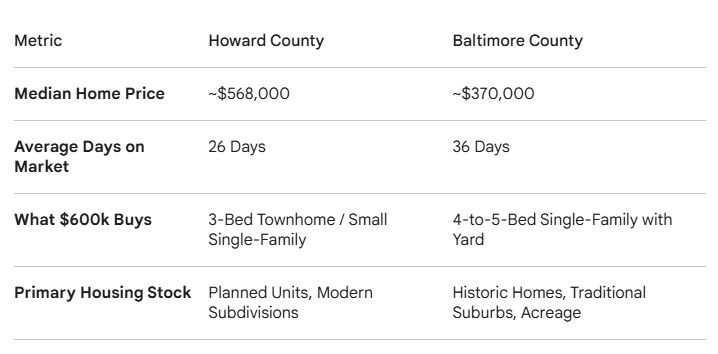
Howard County holds some of the highest median home prices in Maryland. The current median sold price for residential properties sits in the $565,000 to $585,000 range depending on the data source and the month. Homes are moving in an average of 26 days on market, slower than the frantic 2021–2022 pace, but still firmly in seller-favorable territory.
At a $600,000 budget in Howard County, your realistic options include a modern three-bedroom townhome in newer Ellicott City developments, a well-maintained mid-century split-level in one of the Columbia villages, or a tighter single-family home in Elkridge or Savage. Single-family homes over 2,500 square feet with usable yard space generally command $750,000 to $900,000+, especially within the River Hill, Centennial, Marriotts Ridge, and Glenelg high school clusters.
Baltimore County Real Estate Values
Baltimore County presents a much wider price spectrum. The current median home price sits near $370,000, but that number conceals enormous internal range. Median home values in Dundalk and Essex sit in the $230,000–$280,000 range. The Hereford zone and parts of Phoenix-Monkton routinely cross $700,000. Towson, Lutherville-Timonium, and Catonsville land in between.
A $600,000 budget in Baltimore County buys a substantially larger footprint. At that price you can secure a four-bedroom traditional single-family home with a multi-car garage and a half-acre lot in Lutherville-Timonium, Perry Hall, or Catonsville. The same number reaches into the lower end of the Hereford zone for buyers who want acreage. Days on market run notably faster here than in Howard County — Zillow puts Baltimore County's typical pending timeline at around 9 days, which reflects the wider buyer pool drawn by the price diversity.
The Closing Cost Difference Most Buyers Miss
This is where my appraisal background actually changes how I advise clients. The "sticker price" between these two counties is not the whole story. The transaction costs are meaningfully different, and they affect your cash-to-close.
Transfer and Recordation Taxes
- Howard County: 1.25% county transfer tax + 0.5% state transfer tax + $5.00 per $1,000 recordation tax. On a $600,000 purchase, the combined transfer and recordation taxes total roughly $13,500, traditionally split 50/50 between buyer and seller.
- Baltimore County: 1.5% county transfer tax + 0.5% state transfer tax + $5.00 per $1,000 recordation tax. On the same $600,000 purchase, the combined total runs roughly $15,000 — about $1,500 more than Howard County on the identical price point.
Maryland first-time buyers receive a 0.25% state transfer tax waiver in both counties, which shifts the math slightly. The takeaway: Baltimore County carries the higher transaction tax burden, but the lower median home prices typically offset that difference handily.
Property Taxes
The annual property tax rates between these counties are surprisingly close: Howard County sits at roughly 1.014% effective, Baltimore County at roughly 1.03%. The bigger driver of your actual tax bill is the home's assessed value. A $580,000 Howard County home generates an annual property tax bill near $5,880. A $370,000 Baltimore County home generates roughly $3,810. The Howard County tax rate is slightly lower in percentage terms, but the higher home values mean Howard County residents pay the highest median property tax bills in the entire state, around $7,000 annually.
Howard County's Unique Costs
Two specific line items routinely catch Howard County buyers off guard:
- Columbia Association (CA) assessments. If you buy inside one of Columbia's ten villages, you pay an annual CA charge based on assessed value (currently 50 cents per $100 of the first $750,000 of assessed value). On a typical Columbia property, this can add $1,500 to $2,500 per year. The CA funds neighborhood pools, the network of pathways, and the village community centers — real amenities, but a real expense.
- Front Foot Benefit (FFB) assessments. Common in newer Howard County developments (think Maple Lawn, Turf Valley Overlook, and similar communities), FFB fees recover the cost of water and sewer infrastructure installation. They typically run $700 to $1,400 annually for 23 to 30 years from the original installation.
Baltimore County's Unique Costs
The structural cost most often missed in Baltimore County is ground rent — a Maryland-specific arrangement where a separate party owns the land underneath the home and the buyer pays an annual ground rent (typically $50 to $240/year). Ground rent is extremely common in older Baltimore County neighborhoods including Catonsville, Arbutus, Dundalk, Essex, Towson, and parts of Pikesville. It is virtually nonexistent in Howard County.
Ground rent itself is usually not a deal-breaker, but it does require redemption procedures if you eventually want to own the land outright, and unredeemed ground rent has historically caused title surprises at closing. A buyer relocating from another state often has no idea this exists until our title company flags it.
School Systems: Structure and Strategy
For families with school-age children, the school assignment often dictates the entire home search. Both counties offer nationally recognized institutions, but the delivery is structured very differently.
Howard County Public School System (HCPSS)
HCPSS is characterized by consistent, high baseline performance across almost every high school cluster — River Hill, Centennial, Marriotts Ridge, Atholton, Glenelg, Wilde Lake, Howard, Oakland Mills, Long Reach, Hammond, Mt. Hebron, and Reservoir all perform at or above state benchmarks. The county consistently ranks among Maryland's top three public school districts.
That uniformity has a price. A property assigned to a top-tier Howard County cluster routinely commands a premium of $20,000 to $80,000 over a comparable home in a lower-ranked cluster within the same county. Inventory in the highest-demand clusters moves fast. The decision matrix here is less "which school is good" and more "which school cluster fits the size of my budget."
Baltimore County Public Schools (BCPS)
BCPS serves a much larger student body across a much wider geographic area. Performance is regional rather than uniform. Areas like Towson, Hereford, parts of Catonsville, and the Lutherville-Timonium corridor feature high-performing schools that rival any in the state. Other areas perform significantly below those benchmarks.
This variance actually rewards strategic buyers. If you work with an advisor who can identify strong school boundaries within more affordable pockets of Baltimore County, you can find genuine value without sacrificing educational quality. We verify the specific school assignment for every property before you write an offer — not after — because in Baltimore County, three blocks in the wrong direction can place your child in a meaningfully different feeder pattern.
Commute Dynamics and Lifestyle
A house is the launchpad for your daily routine. How you spend your weekday mornings depends entirely on which side of the Patapsco River you choose.
Howard County: Planned, Centralized, Regional
Howard County was built with deliberate intent. Columbia, designed by James Rouse and opened in 1967, anchors the lifestyle. The county features an interconnected pathway network, community pools open to CA members, and centralized commercial hubs around the Mall in Columbia and the Merriweather District.
The Howard County commute profile favors the dual-income household where one professional travels north toward Fort Meade or Baltimore and the other travels south toward Washington, D.C. The combination of I-95, US-29, MD-32, and MD-100 makes regional access genuinely flexible. MARC Penn Line riders have access at Dorsey Station, and BWI Airport sits within 15 minutes of most of the county. Columbia to downtown Baltimore is roughly 30 minutes off-peak, 50 to 55 minutes during rush hour. Columbia to downtown D.C. is similar.
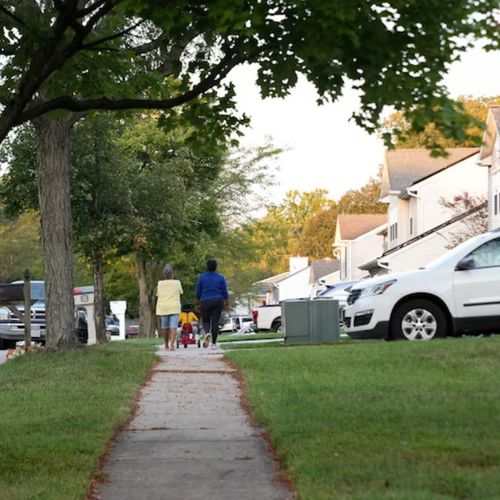
The feel is suburban, manicured, and predictable. Sidewalks are wide, commercial zones are clustered away from residential pockets, and community associations maintain consistent aesthetic standards.
Baltimore County: Varied, Rooted, and Distinct
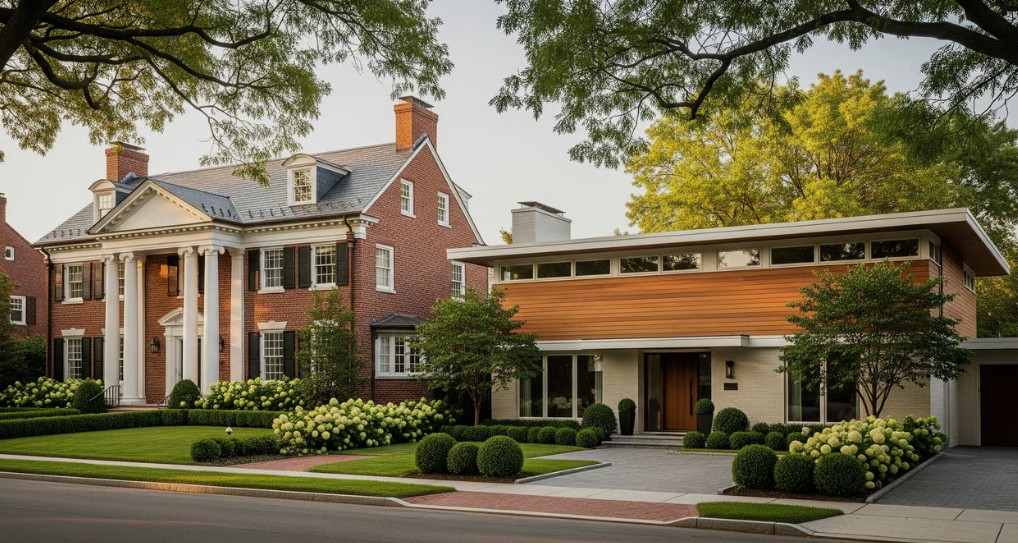
Baltimore County does not follow a single master plan. It is a collection of distinct communities, each with its own cultural identity, architectural style, and history. You can live in walkable, historic Catonsville with its main street and weekly summer concerts, the bustling suburban downtown of Towson, the family-oriented suburbs of Perry Hall and Parkville, or an equestrian property in Monkton or Glyndon.
The commute profile favors those working in Baltimore proper or along the I-695 corridor. Towson to downtown Baltimore is 15 minutes off-peak. Catonsville to downtown is 15 to 20 minutes. Major medical employers including Johns Hopkins, GBMC, St. Joseph Medical Center, and Sinai Hospital are accessible within 30 minutes from most of the county. MARC Penn Line access at Halethorpe and Camden Line access at Dorsey serve commuters heading further south.
The feel is highly varied. It rewards buyers who want architectural character, older trees, walkable main streets, or genuine acreage. It is generally less HOA-driven than Howard County.
Is This the Right Move for Your Situation?
Every family arrives at this crossroad with a different priority stack. Here are three common profiles that map cleanly to one county or the other.
Profile 1: The Federal Commuter Family
Situation: One adult works at Fort Meade, NSA, or in the Columbia–Laurel corridor. The other commutes south toward D.C. or works hybrid in Bethesda. You have two school-age children and you want educational consistency.
Priority: Predictable schools and regional commute access.
Decision: Howard County is built for this exact household. The school system removes the address-by-address research burden, the highway network supports two opposite-direction commutes, and the planned community structure delivers consistent amenities. Budget for the Columbia Association assessment if you choose a Columbia village, and confirm whether any front foot benefit fees apply to the specific subdivision before you write an offer.
Profile 2: The Character-Seeking Move-Up Buyer
Situation: You are leaving a townhome or starter home and you want a larger property with architectural character — old growth trees, mature neighborhoods, walkable main streets, or genuine acreage. You work in or near Baltimore.
Priority: Stretching your dollar, finding a home with story and personality, keeping the commute short.
Decision: Baltimore County. Your $600,000 budget reaches a different category of home here than it does in Howard County. Catonsville, Lutherville-Timonium, Towson, and the Hereford zone all deliver on character, but they deliver it differently. Verify the school assignment at the specific street address, screen the title commitment for ground rent before settlement, and run the actual property tax numbers based on the assessed value — not a rough percentage.
Profile 3: The Relocation Buyer From Out of State
Situation: You are relocating to Central Maryland from somewhere with simpler real estate tax structures — North Carolina, Florida, Texas, or similar. You have not lived through a Maryland transaction before.
Priority: Avoiding surprises at the closing table and choosing the right submarket based on actual lifestyle alignment.
Decision: This is the household that benefits most from a structured comparison before you fall in love with any specific property. The county transfer tax difference, the Columbia Association assessment, the front foot benefit possibility, and the ground rent question can each shift your annual cost of ownership by thousands. We start with a side-by-side analysis of three to five candidate properties from both counties, run the actual all-in cost of ownership, and let the numbers narrow the search.
Frequently Asked Questions
Is Howard County or Baltimore County better for first-time buyers?
It depends on price tolerance. Baltimore County offers significantly more inventory under $400,000, which is where most Maryland first-time buyers transact. Howard County's higher median price point pushes most first-time buyers toward townhomes and condos rather than detached single-family homes. Both counties allow first-time Maryland buyers to claim the 0.25% state transfer tax exemption at closing.
How much does the Columbia Association assessment actually cost?
The Columbia Association charge is calculated annually based on a percentage of your assessed property value (currently 50 cents per $100 of the first $750,000 of assessed value). On a typical Columbia home assessed at $475,000, the annual CA assessment runs roughly $2,375. The fee funds the village pools, community centers, the pathway network, and CA-run programs. It is not optional if you live within a Columbia village.
What is ground rent and how do I know if a Baltimore County home has it?
Ground rent is a Maryland-specific arrangement where a third party owns the land under your home and you pay a small annual fee (typically $50 to $240) for use of the land. Your title commitment will identify any ground rent obligation tied to a property before settlement. You can also redeem ground rent — essentially buy out the land — for a calculated lump sum if the ground rent holder is available and willing to sell. Ground rent is most common in older Baltimore County neighborhoods including Catonsville, Arbutus, Dundalk, Essex, and Towson.
Which county has better schools overall?
Howard County Public School System ranks higher on most published statewide composites, primarily because performance is uniform across nearly every cluster. Baltimore County Public Schools has equally strong top-tier clusters — Hereford, Towson, parts of Catonsville, and Dulaney specifically — but the system also includes schools that perform below those benchmarks. For families prioritizing predictability, Howard wins. For families willing to research, Baltimore County offers strong options at lower price points.
Will my commute be longer in Howard County or Baltimore County?
It depends on where you work. If you commute into downtown Baltimore or along I-695, Baltimore County is meaningfully shorter — typically 15 to 25 minutes versus 30 to 50 minutes from most of Howard County. If your commute includes Fort Meade, Columbia, BWI, or anywhere in the D.C. metro, Howard County's central position is the advantage.
Are property taxes higher in Howard County or Baltimore County?
The percentage rates are nearly identical — Howard County at roughly 1.014% effective and Baltimore County at roughly 1.03%. However, because Howard County's median home values are substantially higher, the median Howard County homeowner pays the highest median property tax bill in the state at around $7,000 annually. The median Baltimore County homeowner pays closer to $3,800.
Choosing With Clarity Instead of Pressure
The Howard County vs. Baltimore County decision is not about which county is objectively better. It is about which structural profile fits your household's actual priorities, your commute geography, your school requirements, and your real cost of ownership tolerance.
We do not start with a sales pitch. We start with the data — your commute, your budget, your school priorities — and we map those against the structural realities of each county. We run a side-by-side cost-of-ownership comparison on real candidate properties before you write a single offer.
If you are weighing this decision and want a clear, honest look at how the numbers actually shake out for your specific situation, let's connect.
Check out this article next