

5 Household Items Silently Spiking Your Utility Bill
Opening a utility bill shouldn’t feel like a game of chance. For many homeowners, the monthly fluctuation in energy costs creates a sense of uncertainty that is difficult to plan for. While we often look toward major lifestyle shifts to lower those numbers, the reality is that several "silent" consumers in your home are likely driving up your overhead without you realizing it.
As a real estate advisor, my goal is to help you protect the value of your investment, and that starts with how efficiently your home operates.
Here is how to identify and neutralize the five most common culprits of energy waste.
1. Misplaced or Mismanaged Thermostats
Heating and cooling remain the largest energy expenses in the modern home. However, the issue isn't always the HVAC system itself; it’s often the placement of the thermostat.
If your thermostat is located near a drafty window, a kitchen heat source, or in direct sunlight, it will provide inaccurate readings. This causes your system to cycle longer than necessary to reach a "target" temperature that has already been achieved elsewhere in the house.
The Strategy: Ensure your thermostat is centrally located away from localized heat or cold. Transitioning to a programmable smart thermostat allows the home to run only when occupied, providing a structured approach to climate control.
2. The "Legacy" Refrigerator
We often relegate older refrigerators to the garage or basement as a secondary unit. While convenient, a fridge older than 15 years can be a significant financial drain, often consuming up to 1,000 units of energy annually.
Between aging compressors and degrading door seals, these units work overtime to maintain temperature.
The Strategy: Evaluate the necessity of secondary units. If a backup is required, replacing a 15-year-old model with an Energy Star-certified unit can often pay for itself in energy savings within a few years.
3. "Vampire" Electronics
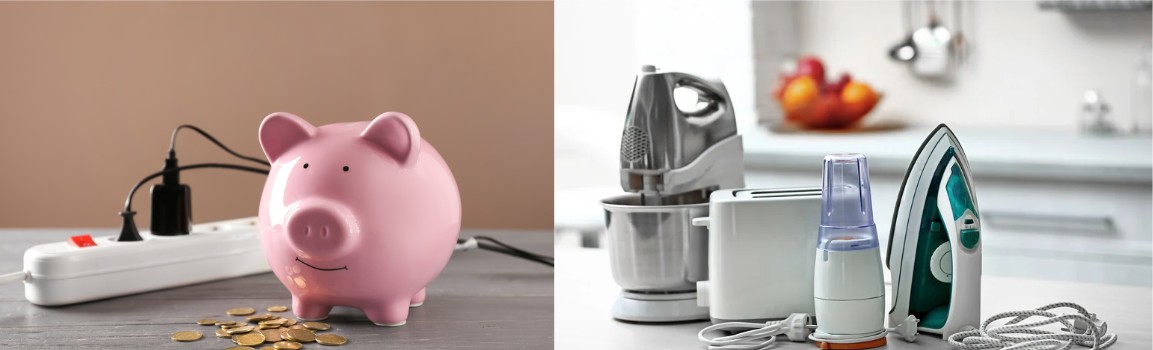
Many homeowners are unaware of phantom energy draw. Devices that remain plugged in, televisions, game consoles, chargers, and even coffee makers, continue to pull electricity even when "off."
If a device has an LED display, a remote sensor, or a bulky power brick, it is likely consuming "standby" power 24/7.
The Strategy: Use smart power strips to cut power to entire entertainment centers or home offices with one switch. Manually unplugging small kitchen appliances when not in use is a simple habit that removes unnecessary "noise" from your electric bill.
4. Neglected Air Filters
A clogged air filter is one of the most common causes of HVAC inefficiency. When air cannot flow freely, the motor must work harder and run longer to circulate air, potentially increasing your cooling or heating costs by 10% to 20%.
Beyond the monthly cost, this added strain shortens the lifespan of your expensive HVAC equipment.
The Strategy: Check filters monthly. Depending on your household (pets, allergies, or dust levels), replace them every 30 to 90 days. It is the least expensive way to protect your home’s most vital system.
5. Over-Calibrated Water Heaters
Your water heater works around the clock to maintain a specific temperature in the tank. Many units are factory-set at 140°F, which is often higher than necessary for standard domestic use.
This high setting leads to "standby heat loss," where the unit consumes energy to maintain a temperature that is actually high enough to cause scalding.
The Strategy: Lower your water heater setting to 120°F. This provides ample heat for showers and appliances while noticeably reducing the energy required for 24-hour maintenance.
The Bottom Line
Managing a home is a series of small, strategic decisions. By addressing these five areas, you move from reacting to your utility bills to controlling them.
Check out this article next