
Outgrowing Your Space? The Move-Up Strategy for Howard and Carroll Counties
There is a specific moment when you realize your starter home is no longer working.
It usually happens when the spare bedroom morphs into a permanent home office, toys begin spilling into the kitchen walkway, or you find yourself fighting for driveway space in a high-density townhouse subdivision. You have outgrown the property.
The natural next step is to look toward the single-family neighborhoods across Howard County or the open-lot communities across Carroll County. But for many families, that ambition hits an immediate logistical wall.
The fear is rarely about qualifying for the next house. The fear is about coordination. How do you sell your current home and buy the next one at the same time without ending up homeless, and without accidentally owning two mortgages at once?
In our current Central Maryland market, inventory remains tight in the most desirable school clusters and on the most desirable lot sizes. Sellers are hesitant to accept offers contingent on the buyer selling their own home first. If you enter the market using outdated tactics, your offers will get rejected and your transition will stall. After nearly 20 years in Maryland real estate, including years on the appraisal side, I have watched dozens of these transitions succeed and fail. The difference is almost always preparation.
Quick Answer
To successfully move up to a larger home in Howard or Carroll County, you have to leverage your current property's equity before listing it. By using tools like a home equity line of credit (HELOC), bridge financing, or negotiating a post-settlement rent-back agreement, you can make non-contingent offers on your next home. This positions you as a competitive buyer while ensuring a single, seamless transition rather than two stressful overlapping transactions.
Key Takeaways
- Contingencies kill deals: In competitive submarkets like Columbia, Ellicott City, Sykesville, and Eldersburg, offers with home-sale contingencies are rarely accepted when other clean offers exist.
- Equity is your leverage: Your starter home likely holds significant untapped equity due to recent Maryland appreciation cycles, but how you access that equity determines your strategy.
- The rent-back cushion: You can sell your home first and stay in it for up to 60 days post-settlement, giving you cash in hand and time to find your next property.
- Maryland transaction costs vary widely by county: Howard County charges a 1.25% county transfer tax. Carroll County charges no county transfer tax at all. Carroll's $10 per $1,000 recordation tax is double Howard County's. These differences directly affect your net proceeds and your cash to close.
- Valuation precision is non-negotiable: Knowing the exact market value of your current home prevents you from overextending on your next purchase.
The Two Submarkets and How They Behave
The transition from starter to move-up looks different depending on which county you target. Both corridors attract buyers chasing strong schools, manageable commutes, and functional square footage, but the inventory and the buyer behavior shape your strategy.
Howard County: The Planned-Community Premium
In areas like Columbia, Ellicott City, Fulton, and Clarksville, the market is defined by highly organized master-planned communities and top-tier HCPSS school clusters.
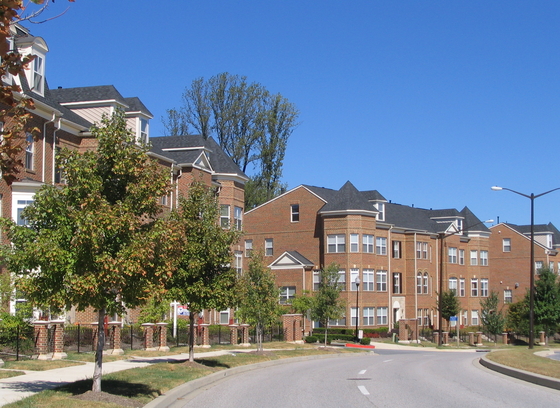
The typical starter asset is a three-story garage townhome built in the late 1990s or 2000s. The move-up target is a detached colonial with a two-car garage and a usable backyard. Homes in the most desirable Howard County pockets currently sit on the market roughly 26 days on average, which is slower than the 16-day pace of 2024 but still firmly in seller-favorable territory for well-prepared, correctly priced listings. The median sale price in Howard County sits in the $565,000 to $585,000 range.
One Howard County-specific item to keep in mind: if you are selling within one of Columbia's ten villages, your buyer will need a Columbia Association resale package, which takes time to order and adds a known cost to the transaction. Plan that ordering window into your listing timeline rather than discovering it the week of closing.
Carroll County: Land, Lifestyle, and No Transfer Tax
Moving into corridors like Westminster, Eldersburg, Sykesville, Mount Airy, Hampstead, and Finksburg gives you very different structural options.
The starter asset in Carroll County might be a smaller townhome in Eldersburg or Hampstead, an older ranch in Westminster, or a starter colonial in Sykesville. The move-up target ranges from larger colonials on half-acre to multi-acre lots, custom builds in newer Westminster-area communities like Sanctuary at Fox Meadow or Enclave at Legacy Farms, or established homes in the higher-priced Mount Airy and Sykesville pockets.
The price spread across Carroll County is substantial. Median home values land near $483,000 countywide, but Sykesville runs closer to $518,000, Mount Airy approaches $582,000, Finksburg sits near $503,000, while Westminster proper averages closer to $428,000. Days on market run roughly 20 to 37 days depending on submarket and price range.
Carroll County's most significant financial differentiator is structural: there is no county transfer tax. Howard County buyers and sellers split a 1.25% county transfer tax on every transaction. Carroll County skips that fee entirely. On a $600,000 purchase, that single difference saves the buyer and seller a combined $7,500 versus the same transaction in Howard County. The trade-off is Carroll's higher recordation tax of $10 per $1,000 (double Howard County's $5 per $1,000), but the net math still favors Carroll on most move-up transactions.
Three Strategic Paths for the Move-Up Buyer
You do not need to wait for the perfect market to make your move. You need to pick the right execution framework based on your current financial position.
Path 1: Post-Settlement Rent-Back (Sell First, Then Buy)
This is the safest and most common method for unlocking equity without taking on new short-term debt.
First, we list your current starter home. Inside the contract, we require the buyer to grant you a post-settlement rent-back agreement, typically up to 60 days. You officially close on your starter home, the proceeds deposit safely into your bank account, and you continue living in the home as a temporary tenant.
Armed with liquid cash and zero debt from your previous mortgage, you can go shopping for your next single-family home with a clean, non-contingent offer. You move once — straight from the old house into the new house.
Path 2: Equity Extraction (Buy First, Then Sell)
If you find your dream house online before your current home is even staged for photography, you have to move quickly. This path removes timeline pressure but requires stronger financial positioning.
The tool involves establishing a Home Equity Line of Credit (HELOC) or securing a bridge loan against your current home before putting it on the market. You pull your down payment out of your current walls, use it to purchase the new single-family home, move your family in completely, and then place the vacant starter home on the MLS.
One important note on HELOCs: most lenders will only approve a primary-residence HELOC if the property is genuinely your primary residence at the time of application. If your lender knows you are planning to list it within weeks, underwriting can complicate. The conversation has to be carefully structured with your loan officer well before listing.
Selling a vacant, professionally staged townhome often yields a higher sales price than trying to sell a home crowded with kids' toys and moving boxes.
Path 3: Concurrent Settlement (The Precision Target)
This is the classic real estate high-wire act. You find a buyer for your home, put a new home under contract simultaneously, and schedule both settlements on the same day with the same title company.
The catch is that this requires flawless coordination across two transactions. If the buyer for your townhome has a financing delay at 9:00 AM, your purchase at 1:00 PM stalls. I only recommend this route when we have a backup agreement or when the buyer of your current home is fully vetted with an ironclad pre-approval from a reputable local lender.
Knowing Your Net Before You Pick a Path
Before you commit to any of these three paths, the conversation has to start with three questions. What is the realistic current market value of your starter home, and how does that compare to where you actually need to land for the next purchase? Which of the three paths fits your financial situation, your school timing, and your tolerance for short-term complexity? And what is the actual net walk-away number after Maryland transfer taxes, recordation fees, agent commission, and any seller concessions — and what is the all-in cash requirement to close on the new property?
That third question is where most move-up plans fall apart. Sellers focus on the gross sale price and forget that Howard County's 1.25% county transfer tax and the half-percent state transfer tax come off the top before equity becomes available for the next down payment. Carroll County sellers have a friendlier net because there is no county transfer tax, but they often forget that Carroll's higher recordation tax means the cash required to close on the next purchase is slightly higher.
Is This the Right Move for Your Situation?
Every household dynamic requires a different operational setup. Look at these three profiles to see where you align.
Profile 1: The Growing Family in a Columbia Townhome
Situation: You bought a townhome in Kings Contrivance, Long Reach, or Owen Brown five years ago. You now have two kids, a dog, and a home office shoved into a corner of the master bedroom.
Priority: Transitioning into a single-family home within a strong HCPSS cluster without disrupting the school year.
Decision: Path 1 (Rent-Back). Your Columbia townhome is a highly liquid asset that will attract significant attention if priced with appraisal-level precision. Secure the buyer first, negotiate a 60-day rent-back, and target a single-family home in your preferred school cluster with cash in hand. Build the Columbia Association resale package timeline into your listing prep.
Profile 2: The Howard-to-Carroll Lifestyle Upgrade
Situation: You own a townhome or smaller single-family in Ellicott City or Elkridge. You want significantly more land, lower property taxes, and freedom from Columbia Association assessments. Your work either supports remote arrangements or routes toward Baltimore, Westminster, or Frederick rather than D.C.
Priority: Maximum land for the dollar, lower ongoing carrying costs, and a cleaner exit from HOA structures.
Decision: Path 2 (Equity Extraction). Howard County properties carry strong resale liquidity, which makes a HELOC or bridge loan strategy realistic. Extract your down payment, lock down the Carroll County property you want — particularly important for the newer custom-build communities in Westminster, Sykesville, or Mount Airy where good lots move fast — and then list your Howard County home vacant and professionally staged. The Carroll County transaction itself is meaningfully cheaper because of the missing county transfer tax.
Profile 3: The Conservative Carroll County Mover
Situation: You own a starter home in Eldersburg, Hampstead, or Westminster, and you want to scale up to more square footage or a different submarket within Carroll County — Sykesville, Mount Airy, or one of the newer Westminster developments. You refuse to carry two housing notes or use short-term bridge products.
Priority: Absolute financial certainty and a clean within-county transition.
Decision: An extended-settlement listing. We find a buyer for your current property willing to accept a 90-day closing timeline, giving you a comfortable window to find your next home without financial exposure. This approach works particularly well in Carroll County because the absence of a county transfer tax keeps your net proceeds high enough to support a clean down payment on the next purchase without bridge financing.
Frequently Asked Questions
Can I use my current home's equity for a down payment without selling it first?
Yes. By setting up a Home Equity Line of Credit while you are still living in the property as your primary residence, you can withdraw cash for your next down payment. Lenders generally underwrite primary-residence HELOCs differently than they would underwrite a loan on a property already listed for sale, so the tool must be set up well in advance of any listing decision.
What is a home sale contingency, and why is it problematic?
A home sale contingency means your offer on the new house is only valid if you successfully sell your current house by a specific date. Sellers dislike this because it takes their home off the market and ties their success to a property they cannot control. In desirable parts of Central Maryland, contingent offers are rarely accepted when other clean offers exist on the same property.
How much equity do I need to make a move-up purchase viable?
Ideally, you want enough equity to cover a 10% to 20% down payment on your next home, pay off your current mortgage balance, and cover Maryland closing costs, which typically run 3.5% to 5% of the new purchase price for buyers and roughly 3% to 4% of the sale price for sellers before agent commission. Carroll County buyers generally face slightly lower buyer closing costs than Howard County buyers because Carroll has no county transfer tax.
How do Howard County and Carroll County school districts affect my timeline?
In both counties, school assignments influence neighborhood demand. Inventory in top-rated HCPSS clusters drops significantly in the weeks before school starts in late August. Carroll County Public Schools serves a smaller student body across a different geographic footprint, and the highest-demand assignments in Sykesville, Mount Airy, and parts of Westminster show similar pre-school-year inventory compression. If your move is education-dependent, your preparation timeline really needs to start during the previous winter.
What happens if my current home sells but I can't find a new one in time?
A post-settlement rent-back agreement typically gives you a firm 60-day cushion. If your search takes longer, you can transition into short-term corporate housing or a month-to-month rental and put your household items into storage. While temporary moving adds a step, it prevents you from buying the wrong single-family home out of desperation.
How does Maryland's county transfer tax affect my net proceeds?
Maryland's state transfer tax of 0.5% is traditionally split 50/50 between buyer and seller, as is the county transfer tax. In Howard County, that means each side pays 0.875% of the purchase price in combined state-plus-county transfer tax. In Carroll County, each side pays only 0.25% (just the state transfer tax half), because Carroll has no county transfer tax at all. On a $600,000 sale, the seller's portion of transfer taxes alone is roughly $5,250 in Howard County versus $1,500 in Carroll County — a meaningful net difference before agent commission and other costs.
Strategy First, Scale Second
Outgrowing your starter home is a sign of financial progress, but moving up requires a deliberate execution plan. We do not guess at list prices, and we do not write blind, high-pressure offers on properties you cannot afford to maintain after the dust settles.
We start by analyzing the true market value of your current home to figure out exactly how much liquid equity you have to play with. From there, we design a timeline that protects your daily life and positions your next offer to win.
If you want to run the numbers on your current Howard or Carroll County property and map out a clean transition, let's connect.
Check out this article next