Moving to Baltimore? What Out-of-State Buyers Get Wrong About This Market
If you are currently tracking real estate in dense Northeast metros or transitioning out of a mid-tier market like Hartford or Cleveland, you already know the arithmetic isn't working. You are staring at either deeply compromised square footage with punishing property taxes, or outward moves that put you an hour from anything resembling economic infrastructure.
That friction is exactly why Greater Baltimore keeps showing up on the radar of out-of-state buyers. And it should. But the buyers who land well here are not the ones drawn by the headline numbers — they are the ones who took the time to understand how this market actually works before stepping off the plane.
Baltimore is a genuinely complex, hyper-local market defined by sharp jurisdictional boundaries and property law mechanisms you will not encounter anywhere else in the country. A citywide median sale price in the $215,000–$230,000 range looks extraordinary against New York or the D.C. suburbs — but if you approach a historic Baltimore rowhome using the assumptions of your previous state, you will miss the regional markers that dictate long-term value, lifestyle function, and whether your title comes to you clean.
This guide is a plain-English breakdown of what you actually need to know before you write an offer in Greater Baltimore.
Quick Answer
Relocating to Greater Baltimore requires understanding the fundamental divide between Baltimore City and Baltimore County — two entirely separate legal and taxing jurisdictions with different property tax structures, inventory profiles, and architectural realities. Baltimore City offers dense, historic rowhome inventory at a lower median price point ($215,000–$230,000) paired with a nominal property tax rate of $2.248 per $100 of assessed value, though primary homeowners benefit from a city-administered credit that reduces the effective rate by approximately 20 cents per $100. Baltimore County presents suburban detached inventory at a higher median price (approximately $330,000–$360,000) with a significantly lower tax rate of $1.10 per $100. Out-of-state buyers in both jurisdictions must perform specialized due diligence on neighborhood boundaries, the CHAP historic tax credit system, and an ancient Maryland legal mechanism called Ground Rent that has no equivalent in most other states.
Key Takeaways
- The Jurisdiction Divide Is Non-Negotiable: Baltimore City and Baltimore County do not overlap. They have separate school systems, government agencies, and property tax structures. Where you sign a contract determines your tax liability, your building restrictions, and your daily commute.
- The Tax Gap Is Real — But Homeowners Get a Credit: The city's nominal property tax rate ($2.248 per $100) is more than double the county baseline ($1.10). However, owner-occupied city properties qualify for a Targeted Homeowners Tax Credit that reduces the effective rate by approximately 20 cents per $100 — a meaningful reduction that generic calculators miss.
- The Ground Rent System Is a Title Issue, Not Just a Fee: Thousands of Baltimore properties are sold as leasehold estates where a third party legally owns the land beneath the structure. Since April 2023, virtually all Maryland ground rents are now redeemable — but your title agent must verify the registry status before you close.
- CHAP Credits Travel with the Deed: When you purchase a Baltimore City home with an existing, active CHAP historic tax credit, you inherit it. The credit freezes the city tax assessment on improvements for ten years — but it only applies to properties within designated historic districts that received pre-approval before renovation work began.
- Inventory Has Loosened, But Not Uniformly: Baltimore City is carrying roughly 2.7 months of housing supply, providing more room to negotiate than the county. Move-in-ready detached homes in Baltimore County's most desirable corridors continue to trade faster and with less negotiating margin.
Deconstructing the Micro-Markets: City vs. County
The most common point of confusion for out-of-state buyers arriving from metros like Cleveland or Hartford is the structural separation of these two jurisdictions. In Maryland, Baltimore City is an independent municipality. It is not located within Baltimore County.
Where you place your signature on a purchase contract alters your tax liability, your historical building restrictions, and your daily logistics.
Baltimore City
The city's housing inventory is anchored by generations of dense, historic masonry rowhome architecture that you will not find at this price point anywhere else on the East Coast.
The Price Advantage: Current median sale prices in the city are running in the $215,000–$230,000 range depending on the data source and month. A $250,000 to $350,000 budget can reach fully modernized, multi-level homes with contemporary kitchens, exposed brick interiors, and rooftop decks in waterfront and historic infill neighborhoods.
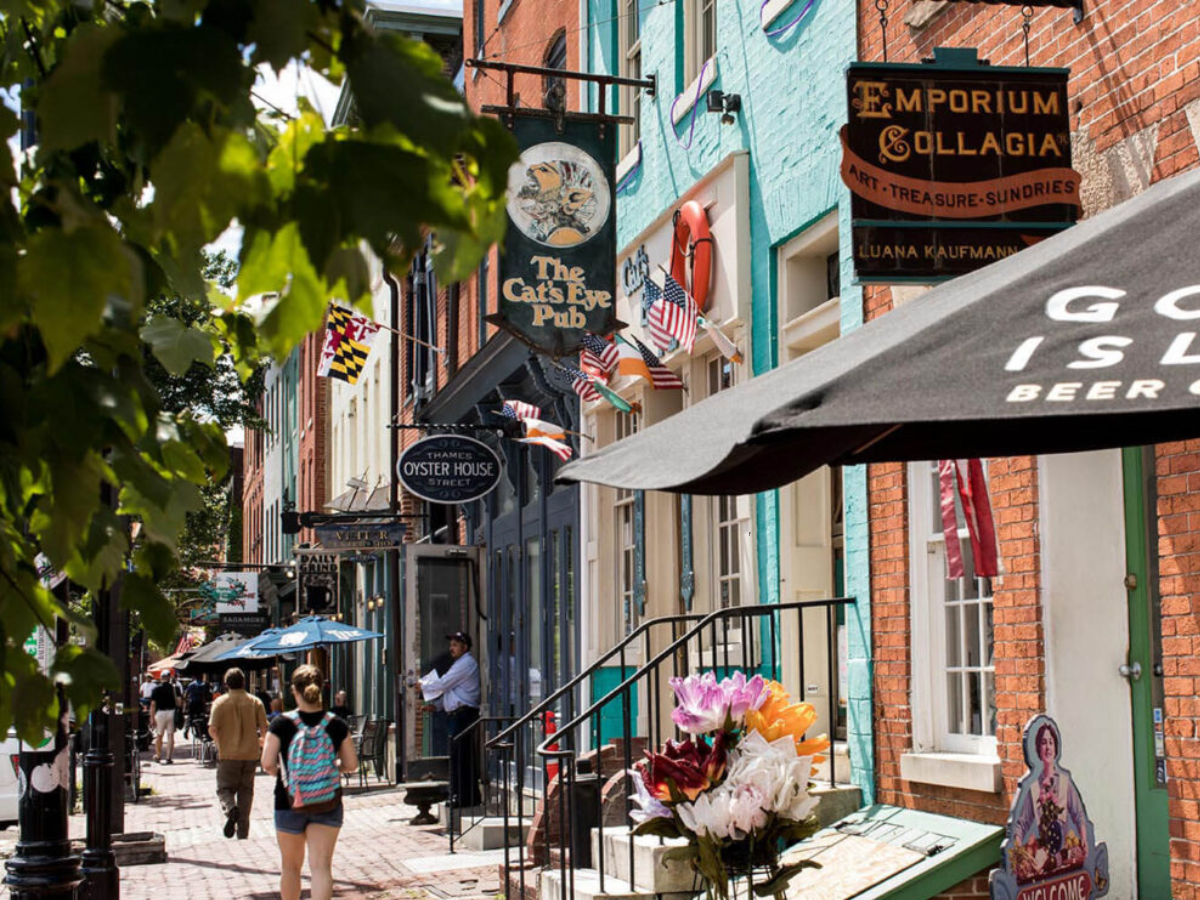
The Neighborhood Matrix: Lifestyle choices here vary block by block. Walkable waterfront corridors — Canton, Fells Point, Federal Hill — attract buyers who want the energy of a real city neighborhood. Bolton Hill offers grand 19th-century architecture with marble stoops and stately proportions. Station North and Greenmount West draw arts-oriented buyers at lower entry prices. Each pocket operates with its own demand dynamics.
The Tax Reality and the Homeowner Credit: The city's nominal real property tax rate is $2.248 per $100 of assessed value — the highest in Maryland. For owner-occupied primary residences, however, Baltimore City administers a Targeted Homeowners Tax Credit that reduces the effective rate by approximately 20 cents per $100, bringing the functional rate to roughly $2.048 per $100 for most buyers who will live in the home. This distinction matters in your monthly payment model and should be explicitly confirmed for any property you target.
The CHAP Credit Opportunity: Savvy buyers target renovated properties that carry an active CHAP historic tax credit, which freezes the city tax assessment on improvements for ten years. The credit is transferable — when you purchase a home that already has it, you inherit the remainder of the term. The one critical caveat: the CHAP credit is not automatic. It requires pre-approval before renovation work begins, a minimum reinvestment of at least 25% of the property's pre-rehabilitation cash value, and the home must sit within a CHAP-designated historic district. A home that was renovated without going through the CHAP process does not qualify retroactively. Verify active credit status directly with CHAP or through your buyer's agent before factoring it into your purchase math.
Baltimore County
If your household needs expansive flat lots, detached structural footprints, and traditional suburban subdivisions, you cross the county line.
The Supply Conditions: Inventory in the county is constrained relative to city supply. Move-in-ready detached homes in sought-after corridors consistently trade quickly, and well-priced single-family product in the county's most competitive submarkets sees limited time on market.
The Price Range: The full-year 2025 county median was approximately $329,000, with current estimates from major indices running in the $330,000–$360,000 range. Premium communities like Towson, Catonsville, and Lutherville-Timonium regularly command $450,000 to $700,000 or more for standard single-family configurations.
The Tax Advantage: The county's base real property tax rate is $1.10 per $100 of assessed value — less than half the city's nominal rate. Even when a buyer pays a higher acquisition price for a county home, the lower monthly tax escrow frequently closes the gap against a lower-priced city asset. Running both scenarios in your mortgage model is the only way to know which produces the better carrying cost for your specific purchase target.
Two Relocation Scenarios: The Strategic Win vs. The Logistical Loss
The Buyer Who Entered Unprepared
A professional relocating from New York spots a fully renovated three-story rowhome online inside city limits for $290,000. Thrilled by the price relative to anything they've seen in New York, they hire an online-only national mortgage broker, skip verifying local tax credits, and write a sight-unseen offer.
They close and move in. The first real property tax bill lands significantly higher than estimated because the home had no active CHAP credit to offset the improvement assessment. Several months later, a legal notice arrives demanding payment on an unregistered ground rent the title agent never flagged. And their daily commute to a corporate office in northern Towson — a short distance on the map — turns into a punishing 45-minute exercise in I-83 traffic every morning.
Every one of those outcomes was preventable.
The Buyer Who Did the Work
An identical buyer working with a local advisory team runs a proper intake before touring anything. They isolate their office location first and map a realistic commute. They evaluate a well-maintained home in a walkable Catonsville corridor at $395,000.
Their mortgage coordinator accounts for exact Maryland transfer and recordation fees upfront. Their title attorney verifies the property is held Fee Simple — no ground rent. The lower county tax rate keeps their monthly carrying cost predictable. Their children enter the school system with a clear enrollment path. Their commute relies on regional arterials rather than city expressways. Nothing surprises them at the settlement table.
The difference between these two outcomes was not luck. It was preparation.
Hidden Maryland Mechanics Every Out-of-State Buyer Must Understand
When you move to Baltimore, you encounter real estate mechanisms that simply do not exist in most of the country. Build these into your relocation checklist before you tour anything.
The Ground Rent System
Dating back to 18th-century colonial English common law, thousands of Greater Baltimore properties are sold as leasehold estates rather than Fee Simple. You own the physical house — the walls, the roof, the improvements — but a third-party ground rent holder legally owns the land beneath the structure. You are required to pay a semi-annual fee, typically modest in annual dollar terms ($50–$200 per year is common), to the ground rent owner.
The financial cost is minor. The title risk is not. If prior owners missed payments, the ground rent holder can move toward possession proceedings. More importantly for buyers: ground rent status must be explicitly verified against the Maryland SDAT Ground Rent Registry before you close. Your title attorney, not your agent, needs to pull this record and confirm the title chain.
As of April 2023, virtually all Maryland ground rents — including those previously designated as "irredeemable" — are now legally redeemable. The buyout price is calculated using a statutory cap rate formula set by Maryland law (Real Property Article §8-804) that varies by the date the original lease was created. In practice, redemption prices are often modest. Maryland's Department of Housing and Community Development also administers a Ground Rent Redemption Loan Program for income-eligible homeowners who want to convert to Fee Simple but cannot fund the buyout outright.
Multi-Wythe Brick and Flat Roof Maintenance
If you buy a classic city rowhome, you are purchasing a structure where the brick is the load-bearing frame — not a wood-framed house with a thin cosmetic brick veneer. These historic structures use two to three layers of solid clay brick bound with flexible lime mortar, and they require a different maintenance approach than anything you have likely owned before.
The single most important rule: never let a contractor repair these walls with modern Portland cement. Portland cement is rigid and waterproof, which sounds like an improvement but is actually destructive — it traps moisture inside the softer historic brick, where it freezes and expands in winter, causing the brick faces to crack and crumble (a process called spalling). Only lime-based mortar — matching the original — should be used for repointing.
Flat and low-slope roofs are standard on city rowhomes. They use modified bitumen or TPO membrane systems and require routine maintenance, including periodic elastomeric coating to protect seams from UV degradation and pooling water. Budget for this as a recurring operating cost.
Your Right to Select the Title Company
Maryland law gives the home buyer the absolute, unilateral right to select the settlement agent and title insurance provider. This matters more in Greater Baltimore than almost anywhere else, because ground rent clouds, unregistered city liens, historic water balance issues, and complex multi-party deed chains are real local title risks. Exercise this right by selecting a title attorney with demonstrated Baltimore experience — not a national settlement company that processes volume and misses local complexity.
Which Baltimore Submarket Fits Your Transition?
Your Situation: You are relocating for a career placement at Johns Hopkins University, the University of Maryland Medical System, or a downtown financial institution. You want walkable daily infrastructure and no suburban yard maintenance.
Your Priority: Active neighborhood life and predictable carrying costs inside the city tax structure.
Your Decision: Focus on Canton, Fells Point, Federal Hill, Mount Vernon, or Locust Point. Target fully renovated city rowhomes or contemporary condominium units. Prioritize properties with active, transferable CHAP historic tax credits with meaningful remaining terms to offset the city tax baseline. Confirm homeowner credit eligibility for your specific parcel.
Your Situation: You need to balance a hybrid work routine that requires traveling south toward Washington D.C. or the Fort Meade/NSA corridor while maintaining access to Baltimore-area employment.
Your Priority: Commute flexibility in both directions, larger lot, detached footprint.
Your Decision: Focus on southwestern county corridors — Catonsville, Arbutus, and the Ellicott City and Columbia submarkets further west. These zones offer direct access to the I-95 corridor and regional MARC train stations, allowing north-south commute flexibility while capturing larger lots and stable detached inventory profiles at county tax rates.
Your Situation: You want established tree-lined streets, premium school district access, and highly predictable detached asset appreciation over a long holding horizon.
Your Priority: Long-term equity stability and community infrastructure quality.
Your Decision: Target Towson, Lutherville-Timonium, Owings Mills, or Perry Hall. Come to the market prepared: pre-approval in hand, contingency timelines tightened, and a buyer's agent who can move quickly on well-priced product before it accumulates competing offers. The county's best corridors do not wait.
Frequently Asked Questions
Is Baltimore more affordable than other East Coast metros?
Compared to New York, Boston, and nearby Washington D.C., Greater Baltimore's cost of living is meaningfully more accessible, and the housing market represents one of the most significant affordability advantages on the northeastern seaboard. That said, the city's property tax rate and the county's constrained inventory both require careful financial modeling rather than surface-level price comparisons.
What is the current median home price in Baltimore?
The market operates on a dual track. Baltimore City median sale prices are running in the $215,000–$230,000 range, anchored by historic rowhome inventory. Baltimore County medians have been tracking in the $330,000–$360,000 range, driven by the dominant presence of detached single-family homes and tighter active inventory.
How do I check if a Baltimore City home has an active CHAP tax credit?
Contact CHAP directly at [email protected] to request a certification letter confirming active credit status. Your buyer's agent can also cross-reference the property address with CHAP staff before you go under contract. Do not rely solely on seller disclosure — request independent confirmation.
Can I buy out a Ground Rent and convert to Fee Simple?
Yes. Since April 2023, virtually all Maryland ground rents are redeemable under state law. The buyout is calculated using a statutory formula based on the annual rent amount and the date the original lease was created. In many cases the redemption cost is modest. Maryland DHCD also administers loan assistance for income-eligible homeowners who want to redeem but cannot fund the buyout outright. Your title attorney can walk you through the specific calculation for any property you are considering.
What commuter transit options serve the region?
The Baltimore metro is served by the MTA Light Rail system, the Metro SubwayLink network, and regional bus lines. For buyers who need to commute south toward Washington D.C., the MARC train system — both the Penn and Camden lines — offers a reliable, lower-stress alternative to I-95 traffic.
Your Pre-Trip Checklist
Coordinating an out-of-state relocation does not have to be a high-stakes gamble. When you replace automated online search results with jurisdictional awareness, hyper-local market data, and a clear understanding of Maryland property law, you convert a major life transition into a predictable financial outcome.
Before you book your first house-hunting trip, run this single strategic exercise:
Identify your target office location on a map. Draw a realistic commute boundary based on your actual tolerance — not a geometric distance, but a timed drive or transit route under real conditions. Isolate the neighborhoods intersecting that boundary, then run dual payment models: one using the city's effective rate for owner-occupied properties and one using the county's $1.10 baseline. Apply current median prices to each scenario. That exercise will tell you which jurisdiction produces a viable purchase — before any particular house has the chance to override your judgment.
If you want a data-grounded advisory partner to analyze Greater Baltimore inventory, decode ground rent records, and build a relocation strategy that holds up to scrutiny, reach out us at the Porchlight Property Group.
Check out this article next