What a Baltimore City Rowhome Actually Returns in 2026 — The Complete Math
Let me take a position right upfront.
A Baltimore City rowhome purchased correctly in 2026 is one of the most compelling small residential investments available in the Mid-Atlantic region. Not because the numbers are easy — they are not. Not because the management is passive — it is not. But because the combination of purchase price, rent level, appreciation trajectory in specific corridors, and tax incentive availability creates a return profile that comparable markets simply cannot offer to investors willing to do the work.
The investors who lose money on Baltimore rowhomes are not losing because Baltimore is a bad market. They are losing because they bought the wrong property, used the wrong expense assumptions, or both.
This post takes one specific deal — a real Baltimore City rowhome acquisition at 2026 market prices — and runs the complete math from acquisition through stabilized operation. No optimistic assumptions. No national average expense loads. Baltimore numbers for a Baltimore investment.
TL;DR: Baltimore City rowhomes in the $85,000 to $140,000 range in revitalization-adjacent corridors produce cap rates of 5.5% to 7.5% for investors who buy correctly and manage proactively. Monthly cash flow with conventional investor financing is near zero to slightly negative — but monthly cash flow is only one of four return sources. The complete five-year return on invested capital for a correctly structured acquisition is approximately 14% annualized. The BRRRR strategy and FHA house hacking both improve that return significantly for investors who can execute them.
The Property: What We're Analyzing
This analysis uses a property that represents the typical Baltimore City rowhome investment opportunity available right now — not a cherry-picked outlier, but the kind of property a serious investor can find and acquire with reasonable effort in 2026.
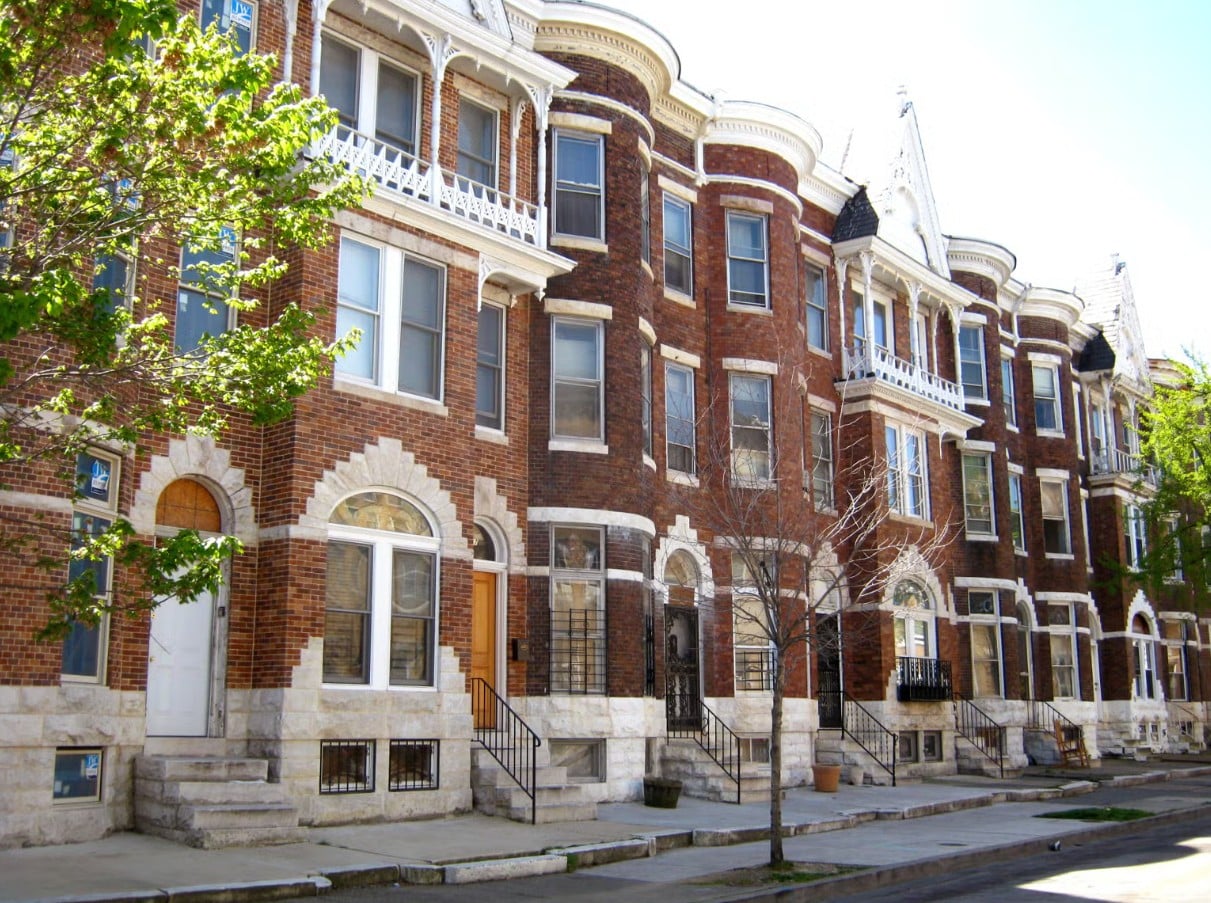
A 3-bedroom, 1.5-bathroom Baltimore City rowhome built approximately 1920 to 1940. Around 1,200 square feet above grade with a partial unfinished basement. Brick exterior with a newer roof within the past five years. Updated kitchen and bathroom within the past three to seven years. Original hardwood floors in good condition. Forced air HVAC system five to eight years old, electrical panel updated to 100-amp service. Located in a Northeast or Northwest Baltimore revitalization corridor.
List price: $115,000. Condition: move-in ready for a tenant, no immediate capital requirements.
This is not a distressed property requiring renovation. That analysis comes in the BRRRR section below. This is a stabilized rental acquisition — the simplest entry point for investors who want to understand the base case before layering in renovation complexity.
Acquisition Costs: What It Actually Costs to Close
The purchase price is $115,000. Here is what you actually spend to close.
Down payment at 25% is $28,750, producing a loan amount of $86,250. Closing costs break down as follows: lender origination and underwriting fees $1,800, title and settlement fees $1,400, Maryland recordation tax on the $86,250 mortgage at $4.95 per $1,000 is $427, Maryland state transfer tax at 0.5% of $115,000 is $575, Baltimore City transfer tax at 1.5% of $115,000 is $1,725. Total closing costs: $5,927. Total cash to close: $34,677.
Every Baltimore City investment acquisition should also be capitalized with a minimum $5,000 to $8,000 reserve fund at closing for immediate repairs, tenant acquisition costs, and the unexpected item that appears within the first 90 days of ownership regardless of how thoroughly you inspected the property.
Total capital required for this acquisition: $42,177. Not the $28,750 down payment. Not the $115,000 purchase price. $42,177 in total deployed capital to own this property stabilized. That is the real number.
The Financing
Investor property financing in 2026 runs 1% to 1.5% above owner-occupied conventional rates. With owner-occupied 30-year fixed rates near 6%, investor financing is currently running 7% to 7.5% for well-qualified investors with strong credit and adequate reserves.
This analysis uses 7.25% — a realistic rate for a qualified investor with a 720-plus credit score and documented rental income history.
Loan amount: $86,250 at 7.25% over 30 years produces a monthly principal and interest payment of $589.
The Rent Analysis
This is where Baltimore investment projections most commonly go wrong. Investors look at Zillow rent estimates, or worse, at what properties are listed for rather than what they are actually leasing for, and build their analysis on a number that doesn't reflect market reality.
A 3-bedroom, 1.5-bathroom move-in ready rowhome in Northeast or Northwest Baltimore's revitalization corridors is currently leasing for $1,200 to $1,400 per month to qualified tenants. The $1,200 end represents properties on blocks with mixed occupancy and higher tenant turnover. The $1,400 end represents properties on strong owner-occupied blocks in active revitalization corridors with lower vacancy and better tenant quality.
This analysis uses $1,300 per month as the stabilized rent — achievable on a well-maintained property in a good location with competent management, not an optimistic projection.
Annual gross rental income at stabilized occupancy: $15,600.
The Complete Expense Analysis
Property taxes at Baltimore City's combined rate of approximately $2.248 per $100 of assessed value, applied to a conservative assessed value of $100,000, produce annual property taxes of $2,248 — $187 per month.
Rental property insurance for a standard Baltimore City rowhome runs $1,200 to $1,800 per year. This analysis uses $1,500 annually — $125 per month.
Maintenance and capital reserves for a 1920 to 1940 rowhome in move-in ready condition should be budgeted at 1.5% of purchase price annually. This accounts for the age of the systems, the probability of plumbing issues in cast iron drain lines, ongoing exterior maintenance of older brick construction, and the capital replacement cycle for HVAC, water heater, and roof. Annual maintenance reserve: $1,725 — $144 per month.
In year one on a move-in ready acquisition you will likely spend less than $1,725 on maintenance. That doesn't mean the reserve is wrong. It means you are building the reserve that will be drawn on when the furnace fails in year three, the drain line backs up in year two, and the roof needs spot repairs in year four. The reserve is not an annual expense — it is a smoothing mechanism for lumpy future capital requirements.
Property management at 9% of gross collected rents: $117 per month.
Vacancy allowance at 8.33% — approximately one month per year — on a properly priced and managed rowhome in a Northeast or Northwest Baltimore revitalization corridor: $90 per month.
Water and sewer in Baltimore City runs $60 to $90 per month on most rowhome properties regardless of whether it's passed through to the tenant. This analysis uses $75 per month.
Exterior maintenance including snow removal, occasional lawn care, and gutter cleaning: $50 per month.
Total monthly expenses excluding mortgage: $788. Annual operating expenses: $9,456.
The Numbers
Annual gross rent: $15,600 Annual operating expenses: $9,456 Net operating income: $6,144 Monthly NOI: $512 Cap rate: 5.34%
That is an honest Baltimore City rowhome cap rate in 2026 on a move-in ready acquisition in a revitalization corridor. Not 8%. Not 10%. 5.34%. Anyone telling you they are buying Baltimore City rowhomes at 8% cap rates in 2026 is either buying in significantly more challenging neighborhoods, using expense assumptions that won't hold in practice, or buying distressed properties at prices below this range that require renovation investment before reaching stabilized operations.
Monthly cash flow after debt service: $512 NOI minus $589 mortgage payment equals negative $77 per month.
At 25% down with conventional investor financing at 7.25%, this property does not cash flow positively on a monthly basis. It is effectively break-even to slightly negative.
This is the honest answer that most Baltimore investment content doesn't give you. But monthly cash flow is not the complete return picture — and evaluating this investment on cash flow alone misses three of the four sources of return.
The Complete Return Picture
Principal paydown on a $86,250 loan at 7.25% produces approximately $5,200 in equity built through the amortization curve over five years — equity built through your tenant's rent payments covering a portion of the mortgage.
Appreciation in Baltimore City's revitalization corridors at a realistic 4% annually on a $115,000 property produces $4,600 in year one, compounding to approximately $24,980 over five years. The property reaches an estimated value of $140,000.
Tax advantages include annual depreciation of $3,764 on a depreciable basis of approximately $103,500 divided over 27.5 years. At a 24% marginal tax rate that produces approximately $903 in annual tax savings — $4,515 over five years. All operating expenses including property taxes, insurance, maintenance, management fees, and mortgage interest are also deductible against rental income.
Management quality as a return driver is a variable most investment analyses treat as fixed. A well-managed Baltimore rowhome kept in superior condition relative to competing rentals commands a rent premium of $75 to $150 per month. Over five years, consistent premium rents of $100 per month above the base case produce $6,000 in additional gross income.
The complete five-year return picture: principal paydown $5,200, appreciation $24,980, depreciation tax savings $4,515, net cash flow approximately negative $4,620. Total five-year return before transaction costs: $30,075. Return on the $42,177 invested capital: 71.3% over five years, or approximately 14.3% annualized.
The investors who dismiss Baltimore because the monthly cash flow is near zero are ignoring the three return sources that represent the majority of the total return.
The BRRRR Analysis
The Buy Rehab Rent Refinance Repeat strategy is how sophisticated Baltimore investors dramatically improve their returns relative to the stabilized acquisition analysis above.
A distressed rowhome in a revitalization corridor purchased at $65,000 needing full kitchen and bathroom renovation, new HVAC, updated electrical to 200-amp service, and cosmetic work throughout carries a realistic renovation budget of $45,000 — producing an all-in cost of $110,000.
After renovation value: $140,000. This is the critical number. Confirming the ARV before you buy is the single most important step in the entire BRRRR process.
Refinancing at 75% of ARV produces $105,000 — recycling $40,000 of the $65,000 acquisition cost back out of the deal. With the $45,000 renovation cost partially offset, remaining capital in the deal is approximately $12,500 plus the $7,500 reserve, totaling $12,500 in total capital remaining invested.
Post-refinance monthly cash flow on the renovated property renting at $1,500: NOI of $552 against the $716 mortgage payment on the $105,000 refinance loan produces negative $164 per month. Still negative — actually worse on a monthly basis than the stabilized acquisition.
But the return on invested capital tells a different story. Total capital invested $12,500, annual principal paydown approximately $1,250, annual appreciation on $140,000 at 4% is $5,600, annual depreciation tax benefit approximately $1,100, net annual cash flow negative $1,968. Total annual return net of negative cash flow: $5,982. Return on $12,500 invested capital: 47.9% annually.
This is why serious Baltimore investors use the BRRRR strategy. Not because the cash flow is better — it isn't. But because the return on invested capital when most of that capital has been recycled out through the refinance is dramatically higher than any stabilized acquisition can produce.
The risk is execution. Renovation cost overruns, ARV not being achieved, and the refinance not delivering the expected cash-out are the three variables that destroy BRRRR returns. Mitigating those risks requires accurate renovation scoping, honest ARV analysis, and a confirmed lender relationship before acquisition — not assumed after renovation.
The Owner-Occupant Advantage: FHA House Hacking
For investors willing to live in their investment, FHA financing on a Baltimore City rowhome changes the math dramatically.
FHA financing on a primary residence requires 3.5% down — $4,025 on a $115,000 purchase — at a rate currently near 6.25% versus 7.25% for an investor loan. The owner lives in the property for the required FHA occupancy period of one year, then converts it to a full rental retaining the original below-market rate.
Post-conversion monthly cash flow: NOI of $512 against a $695 monthly payment produces negative $183 per month. Still negative, but the entry cost was approximately $4,025 plus closing costs plus reserve — compared to $42,177 for the standard investor acquisition. The return on that dramatically reduced capital base is proportionally higher for any investor who can tolerate the one-year owner-occupancy requirement.
For Baltimore City investors early in their portfolio-building journey who can absorb the living requirement, FHA owner-occupancy is the most capital-efficient entry strategy available in 2026.
What Makes This Investment Not Work
Taking a position means being honest about when the position is wrong.
You paid too much. The entire return analysis depends on a $115,000 acquisition price. Every $10,000 above that reduces the cap rate by approximately 0.45% and pushes monthly cash flow further negative. At $145,000 the investment no longer produces a compelling total return at current financing rates. Know your maximum acquisition price before you make an offer and don't exceed it because you like the property.
Your renovation costs ran over. In the BRRRR scenario, a $55,000 renovation on a $45,000 budget means $10,000 more capital trapped in the deal and the refinance no longer fully recycles your investment. First-time renovators consistently experience 15% to 25% cost overruns on Baltimore rowhome projects. Budget for it before it happens.
The property tax assessment jumps at the next cycle. A reassessment from $100,000 to $140,000 increases annual property taxes from $2,248 to $3,147 — adding $75 per month to operating expenses and pushing an already thin cash flow further negative. Model your five-year return with a tax increase scenario before you commit.
The block doesn't support the rent you projected. A $1,300 rent projection requires a property on a block that supports $1,300 rents. Verify your rent assumption with actual comparable rental listings on comparable blocks — not with Zillow's algorithmic estimate for the zip code.
You underestimated management intensity. Baltimore City rowhome rentals require active management. Maintenance response time, tenant communication, and proactive property inspection matter more in this market than in suburban markets where the tenant pool is different and the housing stock is newer. Passive investors who buy Baltimore rowhomes expecting them to run themselves are consistently disappointed.
What I Would and Would Not Buy Right Now
I would buy a move-in ready 3-bedroom rowhome in the Hamilton-Lauraville corridor at $130,000 to $145,000 with a recent roof, updated electrical, and a property tax assessment below the purchase price. The management environment is better than comparable South and West Baltimore properties, the rent level is achievable, and the appreciation trajectory is supported by real investment activity.
I would buy a distressed rowhome in Park Heights at $60,000 to $75,000 on an owner-occupied block receiving BRNI investment, with a renovation budget of $35,000 to $40,000 and a confirmed ARV of $120,000 to $130,000 based on recent renovated comparable sales.
I would buy a legal Baltimore City duplex in the $180,000 to $220,000 range in Hamilton-Lauraville, Waverly, or Remington with separate utilities and two units renting at $1,200 to $1,400 each. The two-unit structure produces positive cash flow that single-family cannot achieve at current financing rates.
I would not buy a rowhome in any Baltimore City neighborhood at a price that requires more than $1,400 in monthly rent to break even on a total expense basis. I would not buy a rowhome with an original electrical panel, galvanized plumbing, and an original roof regardless of how attractive the purchase price appears. And I would not buy in a neighborhood where I cannot verify the rent assumption with actual comparable rental listings on comparable blocks.
Questions I Hear a Lot
Is the BRRRR strategy still viable in Baltimore in 2026? Yes, with realistic expectations about cash flow after refinance. The BRRRR in Baltimore in 2026 does not produce the cash-flow-positive outcome that BRRRR advocates often present. What it produces is a dramatically improved return on invested capital through equity recycling, with monthly cash flow ranging from break-even to slightly negative. Investors who need immediate positive cash flow should not use the BRRRR strategy at current financing rates. Investors building a portfolio who can tolerate near-zero monthly cash flow in exchange for high returns on recycled capital will find it compelling.
What is the minimum credit score for Baltimore investment financing? Conventional investment property loans typically require 680 to 700 minimum. Better rates and terms are available above 720 and 740. The difference in monthly payment between a 680 and a 740 credit score on an $86,250 investment loan is approximately $45 per month — on a tight Baltimore cash flow profile that difference matters.
Should I use an LLC for Baltimore investment property? The liability protection argument for an LLC is real. The financing complication is also real — conventional investment financing through Fannie Mae and Freddie Mac cannot be placed in an LLC. DSCR loans and portfolio loans that can be placed in an LLC carry higher rates than conventional financing. Most beginning Baltimore investors use personal ownership with adequate landlord liability insurance until their portfolio reaches a scale where the financing tradeoff becomes worthwhile.
How do I find a good Baltimore City contractor? The best Baltimore City renovation contractors are found through referrals from other active investors in the specific neighborhoods you're targeting. The Baltimore Real Estate Investors Association and neighborhood-specific investor Facebook groups are the most productive sources. Never use a contractor you haven't vetted through at least two investor referrals on comparable Baltimore City projects.
What due diligence should I do before buying a Baltimore City rowhome? At minimum: a full home inspection with a Baltimore-experienced inspector who specifically addresses lead paint, knob and tube wiring, cast iron and galvanized plumbing, and roof condition. A title search confirming no outstanding liens, code violations, or open permits. A Baltimore City property tax account review confirming no delinquent taxes. And a block-level assessment of comparable rental listings and comparable sales from the prior 90 days to confirm both your rent assumption and your ARV.
Know the Block. Buy the Price. Manage Proactively.
The cap rates are not spectacular. The monthly cash flow at conventional financing rates is near zero. The management is active, not passive. The neighborhood knowledge required to buy correctly is hyperlocal and not available in any database.
But the total return on invested capital for an investor who buys at the right price, in the right corridor, on the right block, with honest expense assumptions and competent management, is a number that most suburban residential investments cannot match.
The investors who build wealth with Baltimore rowhomes are the ones who go in with clear eyes, honest math, and the market knowledge to buy correctly. The ones who lose money bought the spreadsheet rather than the block.
Check out this article next